
How to Start a Healthcare Career With an Associate Degree
Launch a Rewarding Healthcare Career in Two Years or Less
FranU InsiderThe healthcare field is expected to add more jobs than any other U.S. industry over the next decade — more than AI, renewable energy or anything.
And while the roles that come to mind when you think of healthcare may include doctors, surgeons and nurse practitioners, there are a wealth of other vital roles where you can find your own place in this fulfilling field. An associate degree can provide a fast and affordable route to careers in direct patient care, laboratory work and medical administrative functions.
Benefits of an Associate Degree
Whether you’re a first-time college student starting your career journey or a more seasoned professional looking for a credential that will help you achieve more in your current field, an associate degree is a powerful option.
Why an Associate Degree?
Job-specific Training
Gain the technical knowledge you need to start in your chosen field as soon as you earn an associate degree, while also taking core science classes such as anatomy and physiology, ethics and medical terminology.
Learn Skills for Life
An associate degree leads to roles that demand teamwork and excellent communication, time-management, decision-making and problem-solving skills. You learn all of these and more in your classes and hands-on training.
Better Pay
Associate degree holders earn 18% more than people with a high school diploma alone, according to the U.S. Bureau of Labor Statistics.
Cost-effective
Students have the ability to earn their degree in two years or less, resulting in lower tuition fees and student debt.
Get On-The-Job Training Before You Graduate
Healthcare careers are as demanding as they are rewarding. You’ll be asked to think on your feet every day, making quick decisions that can hold serious consequences.
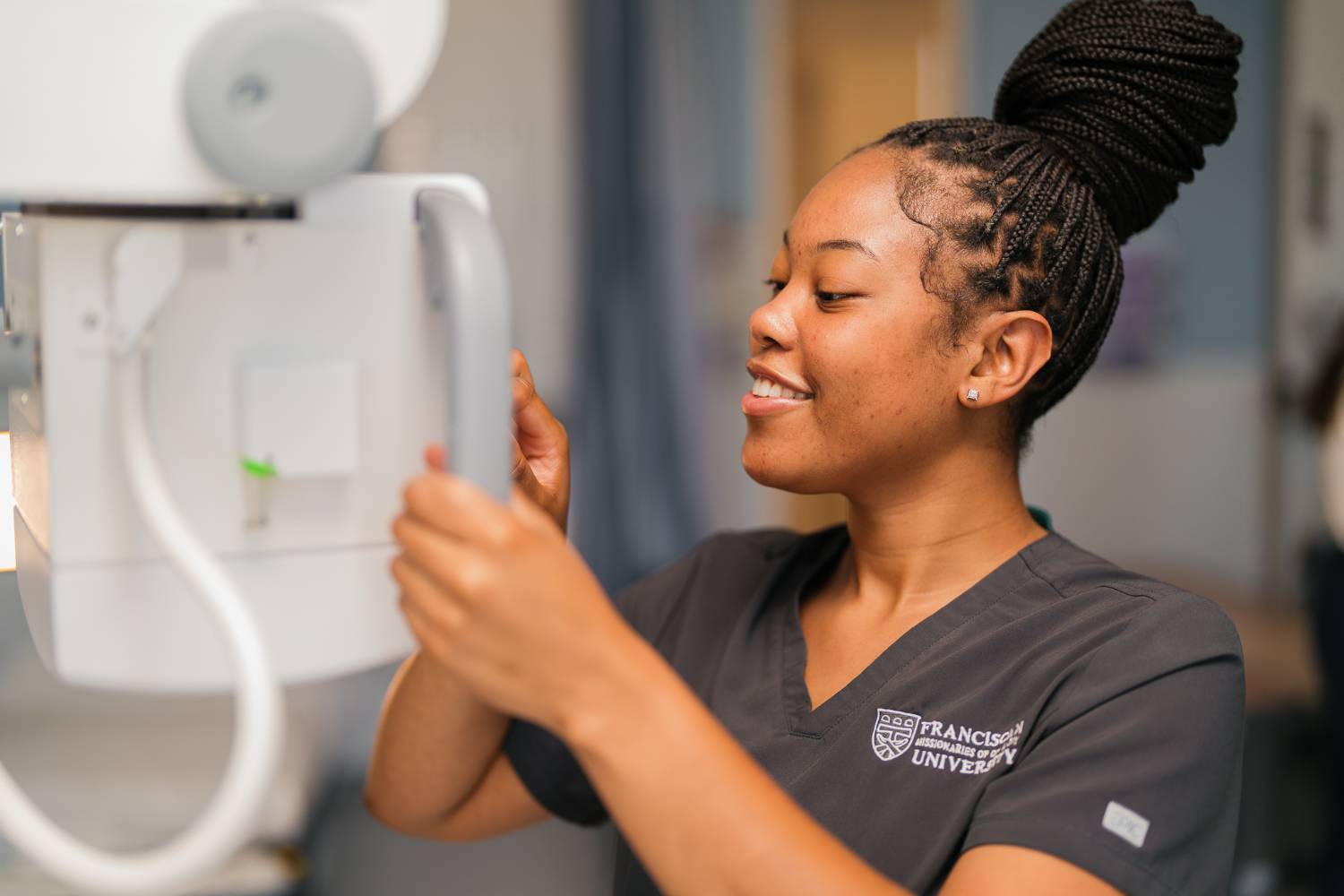
The best way to prepare for those moments is to view them up close. Before you graduate with an associate degree, you’ll get plenty of hands-on clinical experience that prepares you for the rigors of the job. As you work in simulated environments, as well as hospitals and clinics, you can observe the action and then apply what you’ve learned under the supervision of instructors and staff. Often, you train on the same equipment that working professionals use, making it even easier to transition to your job.
Begin Your FranU Journey Today
At FranU, you’ll get a running start on your career, learning in a Franciscan framework that places extra emphasis on service, ethics and compassion. Whether you’re a first-time college student, resuming your education or changing professions, contact FranU to find your spot in this rewarding field.
How Long Does It Take to Get an Associate Degree?
Typically, it takes two years to complete an associate degree, which is about half the time it takes to finish a bachelor’s degree. And because many of the classes you take to earn an associate degree overlap with prerequisites for four-year programs, you can often transfer credits if you decide to continue your education later.
And while an associate degree gives you the technical knowledge you need to start working with patients right away, you’ll also build a toolbox of skills employers expect. You’ll draw on your communication, teamwork and problem-solving skills every day.
Types of Healthcare Roles You Can Pursue With an Associate Degree
Whether you’re looking for a role that puts you in direct contact with patients or would prefer a career in a lab or office, an associate degree prepares you for many meaningful jobs with room for growth.
Depending on the degree you pursue, you could get to work as a:
- Registered nurse. Deliver patient care through all phases of life as an RN. An associate degree will prepare you to take the NCLEX-RN exam and become an RN. While a BSN can lead to leadership responsibilities, an associate degree will accelerate your entry into the field. Necessary degree: Associate in Nursing.
- Radiologic technologist. Work directly with patients and doctors to get diagnostic radiographic images that help in diagnosing and treating diseases. An associate degree can further allow you to specialize in advanced modalities such as computed tomography (CT) scanning, magnetic resonance imaging (MRI), or mammograms. Necessary degree: Associate in Radiologic Technology.
- Physical therapist assistant. Help patients carry out their care, gather data and refine treatment plans under the supervision of licensed physical therapists. Necessary degree: Associate in Physical Therapist Assisting.
- Pharmacy technician. Prepare prescriptions, work with customers and engage with doctors’ offices and insurers in this job. Necessary degree: Associate in Pharmacy Technology.
- Sonographer. Use ultrasound equipment to get images inside a patient’s body, such as muscles, the heart or reproductive organs. Necessary degree: Associate in Diagnostic Medical Sonography.
- Surgical technologist. Prepare operating rooms and provide assistance during procedures. Necessary degree: Associate in Surgical Technology.
- Health information technician. Help organizations comply with patient-privacy regulations and manage healthcare records. Necessary degree: Necessary degree: Associate in Health Information Management.
Start Your Healthcare Career in Just Two Years at FranU
For more than a century, Franciscan Missionaries of Our Lady University has helped students turn their calling into a career. Our two associate degree programs, Physical Therapist Assistant and Radiologic Technology, will equip you with the skills and experience you need to launch your career. Benefit from both caring, expert faculty and advanced on-campus facilities that mimic what you can expect to find once you start working.
Those degrees lead to in-demand jobs: The market for physical therapy assistants is projected to grow 16% by 2034, while roles for radiologic techs are expected to increase 5% in the same time period.